
A World Without Heroes
When Nobody Else Will
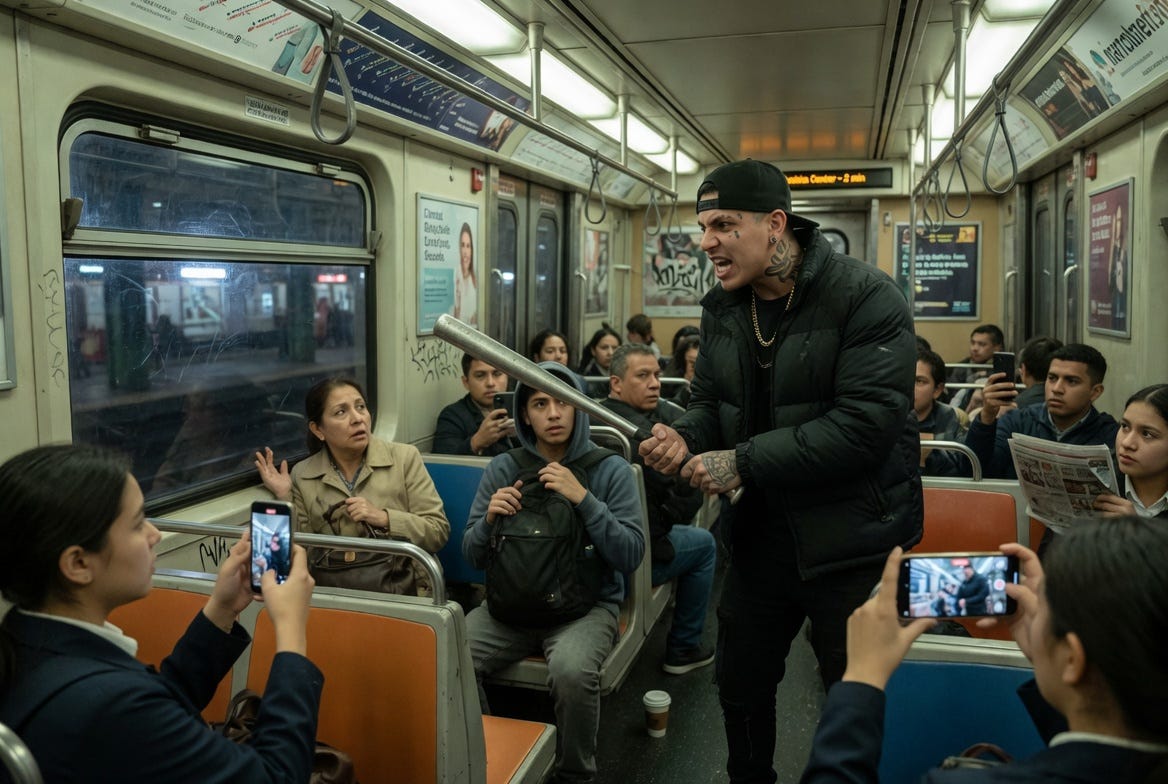
Consider a scene that has happened, in some form, in your lifetime. A man is being beaten on a public bus. The other passengers, perhaps a dozen of them, sit and watch. Some look at the floor or out the window. Several pull out their phones. The beating goes on for two minutes, three minutes, four. By the time it ends, the footage is already uploaded.
We have vocabulary for this. We call it the bystander effect, and we explain it with diffusion of responsibility, social proof, the freezing instinct. The explanations are not wrong. They are also a kind of permission slip, telling us why no one moved, and in telling us why, absolving the not-moving.
Until recently, our culture would have had a different account. It would have said: among those passengers, not one was a man.
That sense of what it means to be a man has been hollowed out. What remains is a vacancy where a certain kind of man used to stand.
The Divine Masculine
The phrase some people use for what is missing is “the divine masculine.” This is not an ideal phrase. It has been colonized by spiritual marketers, twin-flame influencers, and weekend retreats that sell drum circles to men in their fifties. But it points at something the better-known alternatives miss. The thing in question is not warrior glory, not alpha posturing, not patriarchy. It is the willingness to step forward when stepping forward will cost you, on behalf of something that is not yourself.
The clearest image for it is not Achilles or Arthur or Beowulf. It is David.
The boy David, before he was a king or a psalmist. The story is so familiar that most people have forgotten it. The Philistines have a champion, Goliath, who is enormous. He stands on the field each morning and challenges Israel to send out a man. Each morning, Israel does not. The army of God’s chosen people stands in silence while a giant insults them, because none of them will go.
A boy shows up with bread for his brothers. He is too young to fight, unequipped, without armor. He asks why no one is going out, and the answer is: because everyone might die. He goes out.
He goes out with a sling and five stones.
The detail of the five stones is what matters. He did not pick up the first rock he saw, and he did not run shrieking at the giant. He went to the water and selected them from the local stream. He knew the weight he needed and what the sling could do. He looked at Goliath, and he chose his weapon.
This is the archetype. The unlikely one, the volunteer rather than the victor, who steps forward because no one else will, and who steps forward with his eyes open.
Clearly Seeing The Costs
David is one thing. The man who runs screaming at the giant is another. The distinction between them is the whole of what I want to say.
What has replaced heroism in our culture, where anything has replaced it, is mostly recklessness. The man who picks fights on the street, the driver who escalates, the influencer who films himself doing dangerous things for views, the brawler who has confused being unafraid with being courageous, the shooter who has confused grievance with sacrifice. These are not heroes. They are the photographic negative of heroes. They appear brave because they seem to ignore consequences, when in fact they have not looked at the consequences in the first place.
David looked at Goliath. He saw the size of him, and saw what could happen. He picked five stones rather than one, in case the first throw missed, or he had to try again, or it took everything he had. He went forward into a thing he could clearly see was likely to kill him.
Heroism is not blind. It is clear-eyed about cost, and goes anyway.
This is the distinction the manosphere cannot make and does not want to make. It is also the distinction therapeutic culture refuses to make from the other side, by treating any willing acceptance of cost as either pathology or naivety. Both ends of the contemporary conversation collapse the difference between heroism and recklessness. One end sells the collapse as strength, the other as warning. The middle option, the man who sees clearly and goes anyway, has been pushed out of the conversation entirely.
There is another reason this distinction matters. Heroism in its real form has been so successfully conflated with its parody that most reasonable people have stopped trying to defend it. The conflation is convenient. It allows the recklessness of the worst men to be used as evidence that men in general should sit down, and at the same time allows the managed, procedural, lukewarm version of adulthood to be presented as the only mature alternative to chaos. The middle option, the man with clear eyes and chosen ground, has nowhere in the current conversation to stand.
Popular Substitutions
What has filled the vacancy where the heroic father used to stand are two substitutes, both marketed as masculinity, neither of them it.
The first is the Optimizer. He is the dad who would never step forward, because stepping forward is, in his vocabulary, a failure of risk management. He has read the books on emotional intelligence and he uses the word “regulated” frequently. He does not raise his voice at the school board meeting because raising one’s voice is not effective communication, and he does not push back at the dinner table because conflict is a sign of unprocessed material. He has outsourced every decision that might cost him something to a procedure that protects him from the cost. In the name of being a good man, he has become a man no one can rely on for anything that matters. His children love him because he is gentle. They will not call him when they are in trouble, because they sense, without being able to say it, that he will not come.
The Optimizer is the dominant model of educated middle-class masculinity, the man any contemporary HR department was designed to produce. He is unobjectionable. He is also functionally absent from every moment in which presence costs something.
The second substitution is the Performer. He is the manosphere’s product. He has watched Tate, read about high-T living, bought the weighted vest. He talks about discipline as though discipline were the same as courage, which it is not. He is contemptuous of the Optimizer, and he is right to be, but the contempt has not produced anything except a different costume. The Performer’s risks are managed too, simply managed for visibility rather than for invisibility. He will pick a fight on Twitter but will not stand between a stranger and danger. He will cold-plunge for the camera but will not work the night shift for forty years to put two kids through school. He has confused intensity with substance.
The Performer is what the Optimizer becomes when he gets tired of being mocked. The two need each other. The Optimizer’s existence makes the Performer’s posture look like a corrective, while the Performer’s vulgarity makes the Optimizer’s retreat look like wisdom. They are not opposites. They are two faces of the same refusal: the refusal to be the man who has decided, in advance, what he will and will not let happen.
What unites them, what makes them substitutes rather than alternatives, is that neither has done that deciding. The Optimizer has decided he will manage; the Performer has decided he will perform. The man who has decided he will step forward when no one else will is a third thing, and the third thing is rare.
What We Lose
Some readers will hear the foregoing as nostalgia. It is not. What is recoverable is not the past itself, but an archetype that the past sometimes embodied, and that any future could embody, if it chose to.
The cost of the absence is worth being concrete about.
Children raised by men who have never decided are children who learn that the men in their lives will not protect them when called upon. They do not learn this consciously, but in their bodies. The baseline expectation they internalize is that the adult will manage, will document, will refer to the appropriate authority, and will not stand between them and the thing.
Boys, specifically. A boy who grows up watching the men around him optimize their way out of every moment that asks something of them learns, by adolescence, that the adult male world is a place where presence is performed rather than offered. He has watched his father get smaller in the face of difficulty, and seen the men around his father do the same. Nowhere in his actual life has he encountered the third thing. So when adolescence brings him to the question of who he wants to become, the field of available answers contains only two: the Optimizer his father modeled, or the Performer the internet offers. The second one, whatever else can be said about it, at least appears to take up space. He picks accordingly. We then wonder why so many of our young men have ended up where they have. It is not a mystery; it is what happens when the third option is no longer modeled.
Communities without men who have decided are communities that cannot defend themselves against the small, slow encroachments that destroy them: the bullying neighbor, the predatory institution, the local cruelty that requires only one person to say no and gets no one. Civic life run on this principle becomes whatever the most willing-to-be-cruel person wants it to be, because cruelty is willing to bear consequences and the rest of us are not.
A culture without the heroic father is, in the end, a culture that has stopped producing the kind of person around whom anything can be organized. It does not collapse dramatically. It just becomes harder, year by year, to find anyone who will stay when staying is difficult.
This is what we are watching.
Stepping Up
There is no program at the end of this piece. No seven-step plan, no morning routine. No online course can solve this problem. What is being described cannot be product-ized, because what is being described is precisely the willingness to do something that is not in your interest. Anyone selling it as self-empowerment has demonstrated they have not understood it.
The man who steps forward when no one else will is, in almost every case, a man who decided in advance that he would. He did not discover his courage in the moment; he had already done the deciding. The work of becoming the kind of man who steps forward happens in the years before the moment, in small choices nobody sees: the difficult conversation you have rather than avoid, the unpopular position you hold rather than soften, the night shift you work because the money is needed, the standing-between, in small forms, that nobody films and nobody thanks you for. These are the rehearsals. By the time the giant is on the field, it is too late to begin.
Most men, in the moment, discover that they have not decided. This is not because they are bad men. It is because nothing in the culture has asked them to decide, and several things have actively suggested they should not. They have been told by the Optimizer that deciding is grandiose, and by the Performer that deciding is for content. Neither voice has told them what is in fact true: that deciding is what an adult man does, in private, once, and then lives by.
So decide.
Decide what you will not allow to happen on your watch. Decide what you would be willing to lose. Decide in advance of the moment that will reveal it.
End of The Line
Return to the bus.
There are fifteen people on it. The beating is in its second minute, and the phones are out.
Somewhere on that bus, or somewhere on another bus, there is a man who, at some point earlier in his life, decided. He has not thought about the decision in years. It is simply part of how he stands. When the moment comes, he gets up without thinking, because the thinking has already been done.
Whether he stops the beating, or whether he survives it, is not the point. The question is whether our culture still produces people like him.